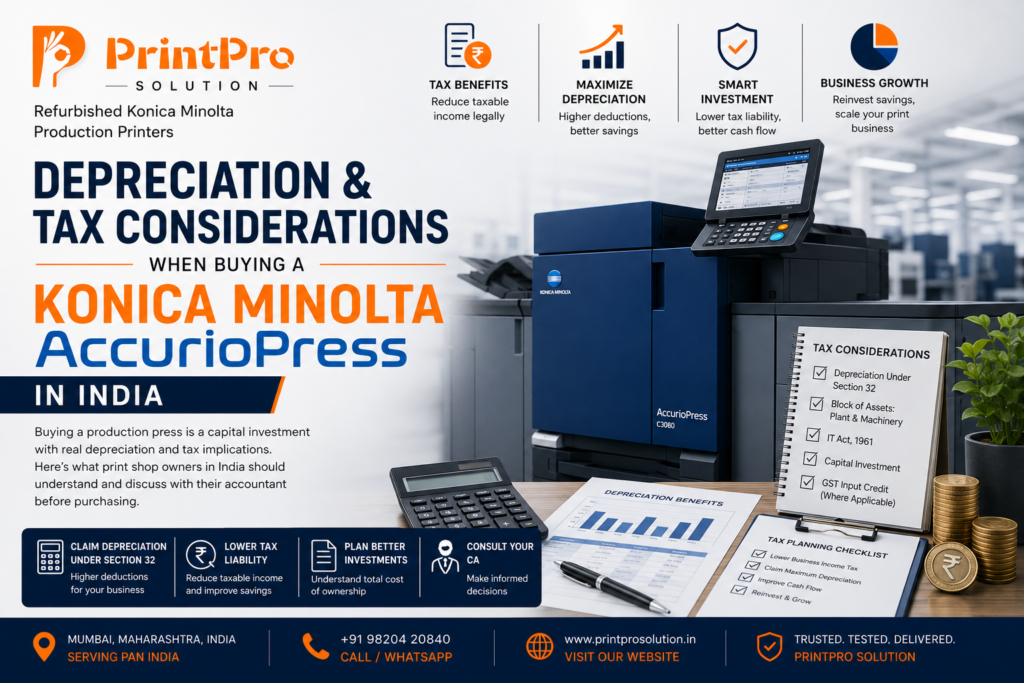
Title: Depreciation & Tax Considerations When Buying a Konica Minolta AccurioPress in India | PrintPro Solution
Meta Description: Buying a production press is a capital investment with real depreciation and tax implications. Here’s what print shop owners in India should understand and discuss with their accountant before purchasing.
Category: Konica Minolta Production Printer
Read time: 6 min read
Pillar: Cost-of-Ownership & Business Economics
Depreciation & Tax Considerations When Buying a Konica Minolta AccurioPress in India
A production press is a capital asset, and how it’s treated for depreciation and tax purposes affects your real, after-tax cost of ownership — a factor that complements the cost comparisons covered in our other pillar-4 guides but requires its own understanding. This guide covers what to think about and discuss with your accountant, not a substitute for that conversation.
Why this matters alongside your other cost calculations
Our real cost-per-print guide and refurbished-vs-new comparison both focus on operational costs. Depreciation treatment affects a different part of the picture — how the capital cost of the machine itself is recognized over time for tax purposes, which can meaningfully affect your business’s actual cash tax liability in the years following purchase.
General concepts worth understanding
Depreciation as a capital asset
Production printing equipment is typically treated as a depreciable business asset, meaning its cost is recognized over a number of years rather than entirely in the year of purchase, following applicable depreciation schedules and rates for the relevant asset category. The specific rate and method depend on current tax regulations, which your accountant can confirm precisely for your situation.
New vs. refurbished treatment
Whether a refurbished machine is treated differently from a new one for depreciation purposes is worth clarifying specifically — this can vary based on how the purchase is structured and documented, and is a good question to raise directly given the emphasis our other guides place on refurbished machines as a legitimate business choice.
GST and input tax credit considerations
Capital equipment purchases typically have GST implications, including potential input tax credit eligibility depending on your business structure and how the equipment is used. This is worth confirming specifically for your purchase, since terms and eligibility can depend on details of the transaction.
Financing structure and interest deductibility
If you’re financing the purchase, as covered in our financing vs outright purchase guide, the interest cost may have different tax treatment than the depreciation on the machine itself — another reason the financing decision benefits from being made with full information rather than purely on monthly payment comparisons.
Why documentation matters more than it might seem
Proper invoicing and documentation — covered from a different angle in our counterfeit consumables guide, but relevant here too — matters for depreciation and tax purposes just as much as for warranty claims. Clear records of purchase price, refurbishment costs if itemized separately, and any financing terms make accurate tax treatment straightforward rather than something reconstructed after the fact.
How this can influence the new vs. refurbished decision
Combined with the operational cost comparison in our refurbished-vs-new guide, understanding the tax treatment of each option gives a fuller after-tax cost picture — in some cases meaningfully shifting the comparison beyond what pure purchase price and operating cost analysis alone would suggest.
This is general awareness, not tax advice
Tax regulations, depreciation rates, and GST treatment change over time and depend on the specifics of your business structure, so this guide is meant to help you know what questions to bring to a qualified chartered accountant or tax advisor, not to serve as advice for your specific situation. Getting this conversation right before or shortly after purchase is far more useful than trying to reconstruct it at year-end.
Want help thinking through the business case alongside the tax conversation?
We can walk you through the operational cost side — real cost-per-print, financing options, and total ownership cost — so you and your accountant have the full picture when working out the tax and depreciation details specific to your business.
Facing this on your machine?
Send your model and the issue - our Konica Minolta experts will help you sort it out.